Five days of encounters and situations with authors, artists and cultural professionals in search of alternative practices for the production and sharing of ideas.
2-6 January 2027
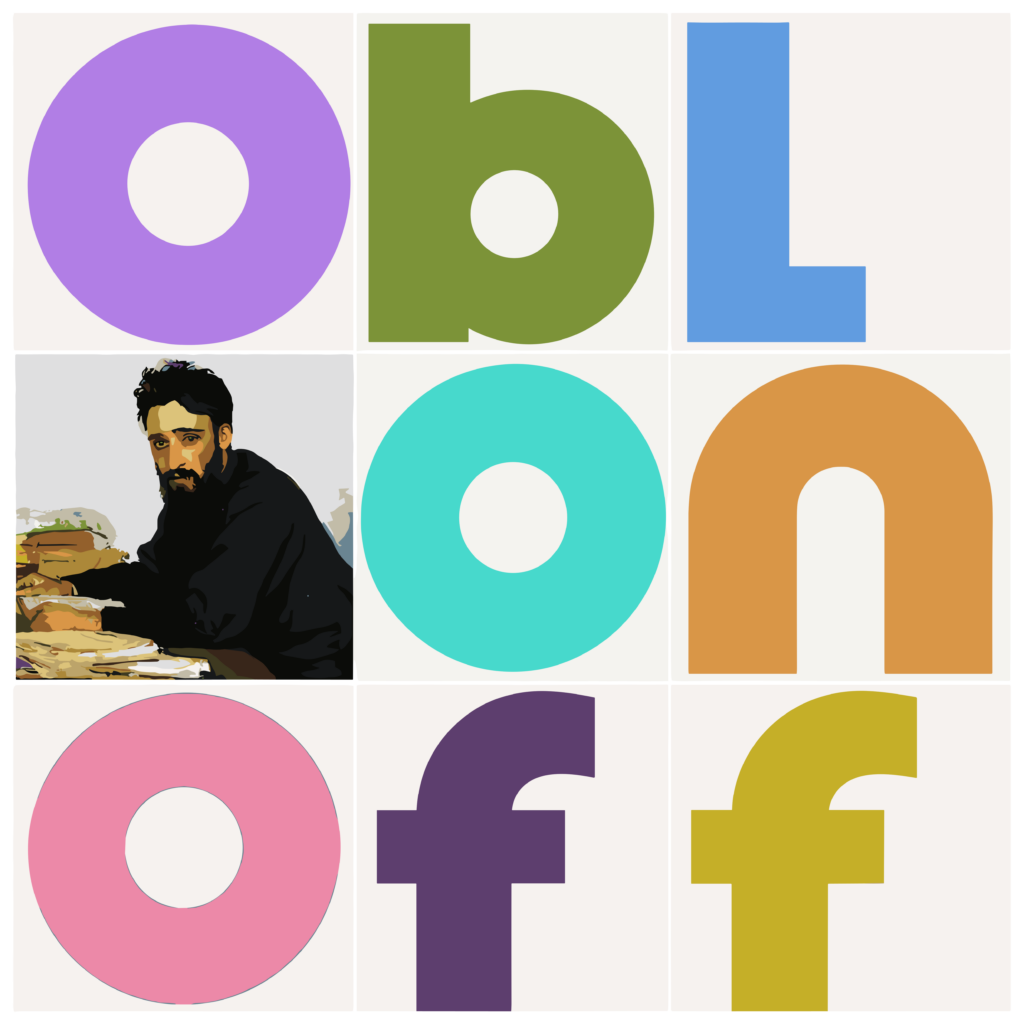
OblOnOff – Apology for Dysfunctionality is a series of interdisciplinary encounters between artists, authors, researchers and cultural practitioners, taking place in Pietrasanta from 2 to 6 January 2027, with its main venue at Art Studio La Marina, Via del Marzocco.
The project stems from a shared desire among several Italian cultural organisations to question the dominant models of cultural production and explore possible alternatives through dialogue and cross-contamination between disciplines particularly open to experimentation: visual arts, performance, research-based writing, with a special focus on media retrospection and the reworking of archives.
In opposition to the toxic effects of the cultural industry, OblOnOff embraces its own dysfunctionality as a method: beginning, for instance, with an improbable schedule, taking place on dates least suited to hypothetical success; rejecting the rules of marketing from the outset, rather than seeking to “harvest” an audience; challenging the very idea of a “passive” audience, and instead encouraging the presence only of those directly involved in the organisation and documentation of the encounters; and freely exploring the possibility of replacing events with informal situations whose outcomes cannot be predicted.
Much like Oblomov, the protagonist of Goncharov’s novel, OblOnOff does nothing that serves any particular purpose, but elevates its own dysfunctionality to the status of a possibility: the possibility of temporarily stepping outside the typical constraints of individual efficiency imposed by the cultural industry for its own ends.
The situations that make up the OblOnOff programme may therefore include historically established alternative practices, such as the TAZ – Temporary Autonomous Zones described by Hakim Bey, various forms of copyleft, opting out of monopolistic and proprietary digital platforms, and other forms of resistance to the logic of dominant industrial processes.
If the project has a purpose, however, it is also to bring the participants’ experiences together in order to discuss and identify new forms of constructive dissent. In doing so, it seeks to send a signal amid the prevailing noise, including that produced by those who, while looking for answers to the same problems, tend to address them from within a cultural system that has by now been deeply compromised.
Particular attention is devoted to archival materials and forms of memory: in a cultural context crushed by the industrial imperative of an eternal present, OblOnOff will reflect on the role of artefacts as elements to be reinterpreted and brought back into relation with the contemporary. The recovery of an expanded temporality and of unrestricted availability are identified as essential keys to revolutionising the ways in which culture is produced, transmitted, archived and made accessible.
From an organisational perspective, the people involved in OblOnOff have been invited to contribute to the programme by taking part in talks, or by producing a piece of research, an artwork, a reading, a performance, or a document relevant to its premises. The aim is to foster a context of exchange and shared, interconnected production, with the complete documentation remaining available in a dedicated, continuously expanding online archive.
An informal and convivial dimension accompanies the more explicitly exhibition-oriented and discursive one, creating opportunities for encounters (“Off”) intended to continue beyond the structured appointments (“On”).
OblOnOff therefore aims to be a temporary and open-ended experiment in cultural production, in which the programme is inseparable from the relationships that shape it and emerge from it. Its unfinished form and open ending are not limitations to be corrected, but essential components of the project. Dysfunctionality, ultimately, belongs more to the method than to the subject: it is the device through which OblOnOff attempts to question its own forms and create an original space for interactions between practices, people and ideas.
In collaboration with: